
Claude vs. GPT vs. Gemini vs. DeepSeek: A Plain-English Guide to the AI Models of April 2026
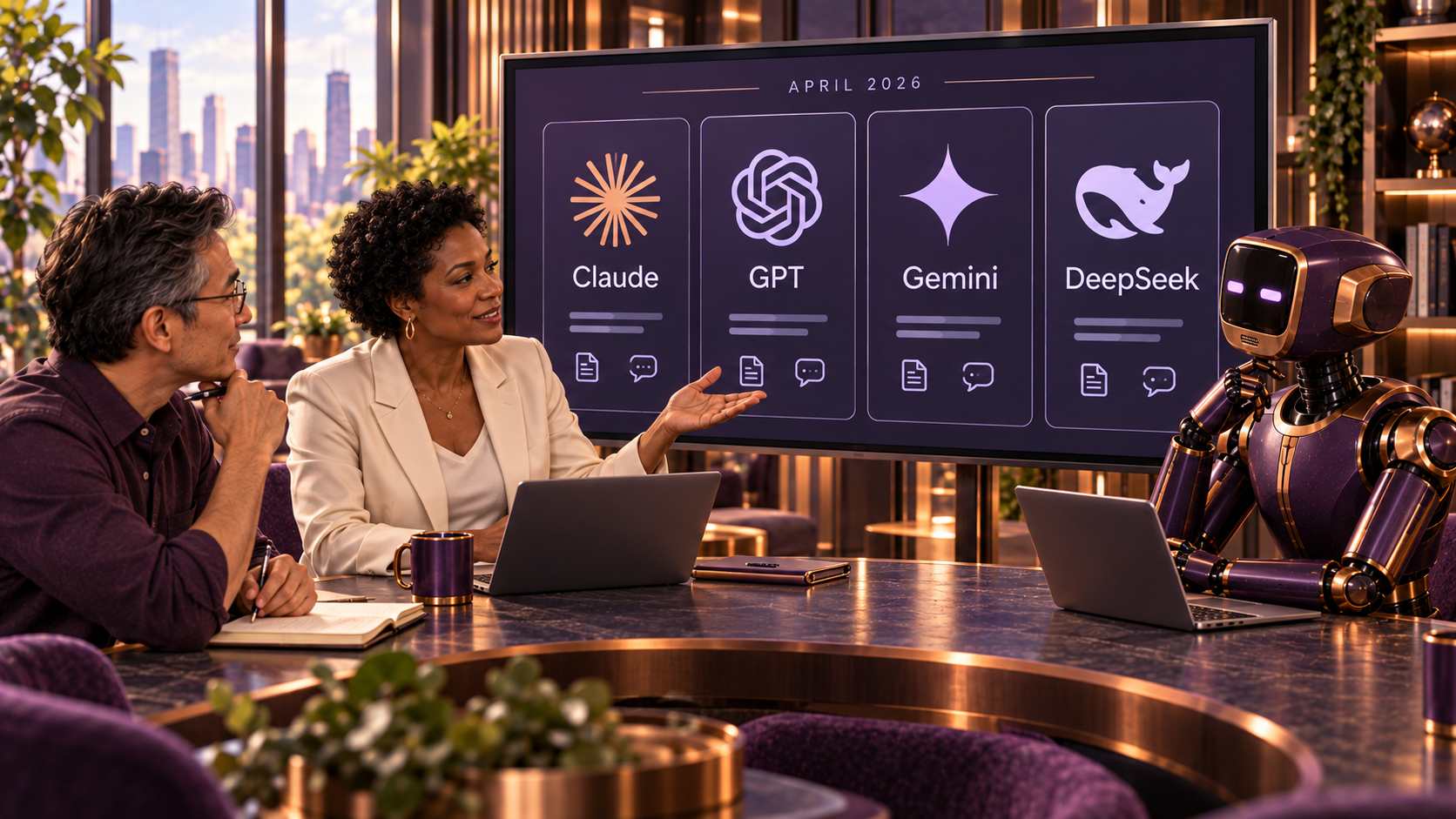
If you've tried more than one AI chatbot lately, you've probably noticed they don't all feel the same. One writes more naturally. One is faster. One seems to "get" complicated requests better than the others. That's not your imagination — the four major AI labs have genuinely split into different philosophies about what an AI assistant should be good at.
We work across all of these models every day building websites, apps, and automation for clients, and we get some version of the same question constantly: "Which AI should I actually be using?" The honest answer is: it depends on what you're doing. So here's our April 2026 snapshot — plain language, no assumed technical background required — of where things stand right now.
The Short Version
If you only remember one thing from this article, remember this: there's no single "best" AI anymore. Each of the big four has picked a lane.
- Claude (from Anthropic) is the best writer and the most careful coder.
- GPT (from OpenAI) is the most well-rounded do-everything tool.
- Gemini (from Google) is the best value and plugs deepest into everyday tools like Search and Gmail.
- DeepSeek is dramatically cheaper and surprisingly capable, with a big asterisk around data privacy.
Let's walk through each one.
Claude: The Careful, Excellent Writer
Anthropic's current top model is called Claude Opus 4.6, with a cheaper, faster mid-tier version called Sonnet 4.6, and an even lighter, budget-friendly version called Haiku 4.5.
If you've ever read something written by an AI and thought "this sounds a little robotic," Claude is usually the exception. It consistently produces the most natural, human-sounding writing of the group — which matters if you're using AI to draft blog posts, emails, proposals, or anything where tone and voice matter.
Claude is also excellent at careful, disciplined coding work — the kind where a small mistake buried in a large codebase could actually cost you money or downtime. It tends to be thorough rather than flashy.
The trade-off: Claude can't "remember" quite as much text in one conversation as Gemini or GPT can, and it doesn't natively generate images, audio, or video the way some competitors do. It's a specialist, not a Swiss Army knife.
Best for: important written content, client-facing documents, and coding projects where accuracy really matters.
GPT: The All-Around Generalist
OpenAI's current flagship is GPT-5.4, and it's built to do a little bit of everything reasonably well — text, images, audio, and even operating a computer or command line on your behalf for automated tasks.
If Claude is a specialist, GPT is the generalist that shows up ready to help with almost anything. It has the largest ecosystem of tools, plugins, and integrations of any AI company, largely because ChatGPT has been the household name in this space the longest.
GPT is also currently the strongest of the group at fully autonomous tasks — things like running a series of commands on its own to complete a multi-step job with less hand-holding.
The trade-off: that versatility comes at a slightly higher cost per use than some competitors, and while it's very good at coding, it narrowly trails Claude on the hardest coding benchmarks.
Best for: businesses and individuals who want one flexible tool that handles a wide variety of tasks without switching between apps.
Gemini: The Value Play With Google Built In
Google's current flagship is Gemini 3.1 Pro, and its two biggest selling points are price and integration.
Gemini is the least expensive of the major paid models to use at scale, which matters a lot if you're running AI-powered features inside your own business software. It also has the largest "memory" of any model in this lineup — it can process an enormous amount of text, video, or audio in a single request, which is genuinely useful for things like analyzing a long recorded meeting or a huge document all at once.
Because it's made by Google, Gemini is also the most deeply woven into tools people already use daily — Gmail, Docs, Search, and Android.
The trade-off: Gemini currently lags behind Claude and GPT specifically on coding tasks, even though it actually leads the pack on general reasoning and problem-solving benchmarks.
Best for: cost-conscious projects, anything involving very long documents or recordings, and businesses already living inside the Google ecosystem.
DeepSeek: The Budget Disruptor (With a Catch)
DeepSeek is a bit of a different animal. Its current model, DeepSeek V3.2, is what's called "open weight" — meaning, unlike the other three, businesses and developers can actually download and run it on their own servers instead of only accessing it through DeepSeek's own service.
The headline feature is price. DeepSeek is roughly a tenth of the cost of the US flagship models for comparable work, and it performs competitively on standard coding and reasoning tasks. For high-volume, well-defined jobs — document processing, categorizing information, first-draft coding — that price difference adds up fast.
Here's the catch, and it's an important one: DeepSeek is a Chinese company, and using its hosted, cloud-based service means your data is processed under that company's jurisdiction. For many businesses — especially anything handling client data, healthcare information, or anything regulated — that's a real consideration, not a minor detail. The open-weight nature of the model means you can download it and run it entirely on your own servers to avoid that concern, but that takes real technical infrastructure to pull off, and it's not a realistic option for most small businesses.
DeepSeek also has documented content restrictions around certain political topics, and it currently isn't quite as reliable on complex, multi-step reasoning tasks as the top-tier US models.
Best for: high-volume, cost-sensitive, well-defined tasks — as long as you've thought through the data-privacy trade-off first.
A Quick Word on Open-Source Models
Beyond these four, there's a growing world of "open-weight" AI models that businesses can download and run themselves rather than paying per use through a company's service. The current leaders in that space are Meta's Llama 4, Alibaba's Qwen 3.5, and Mistral AI's models out of France.
These open models are closing the gap with the big paid services faster than most people realize — on many coding and reasoning tasks, they now trail the top commercial models by only a small margin. Their real advantage isn't raw brainpower, though — it's control. A business that self-hosts one of these models keeps its data entirely in-house, avoids ongoing per-use fees at scale, and isn't dependent on any single company's pricing or policies. That's a serious option for larger or more security-conscious organizations, but it requires real technical setup and isn't a good fit for most small businesses just looking for a simple tool to use day to day.
It's Not Just Between Companies — It's Within Them Too
One thing that trips people up: each of these companies also offers multiple versions of their own model, and the differences between those versions matter almost as much as the differences between companies.
Anthropic, for example, currently offers three tiers of Claude — a top-end version for the hardest problems, a mid-tier version that gets you most of the same quality at a noticeably lower cost, and a lightweight version built for simple, high-volume tasks. The same general pattern holds across the other companies too: a flagship "best" version, and lighter, cheaper versions for everyday use. If you're paying for AI as a business tool, it's worth checking whether you actually need the top-tier version or whether a mid-tier one gets the job done for a fraction of the price.
How We Use This at Media Mechanic
We don't treat any single AI model as our default hammer for every job. Different projects genuinely call for different tools — a long, document-heavy client engagement might lean on a model with a huge memory window; a cost-sensitive automation pipeline might lean on the cheapest capable option; a client-facing deliverable where a wrong answer would be costly leans toward the most careful, reliable option available. We've built client work across several of these model families specifically because matching the right tool to the right job produces better results than committing to one brand out of habit.
That same philosophy is baked into GearHead, our AI assistant currently in private development. Rather than locking users into one company's model, GearHead is built to work across several of these model families depending on the task — so you get the right kind of intelligence for the job in front of you, without having to become an AI expert yourself to make that call.
Bottom Line for April 2026
If you need one AI tool and want the simplest possible advice: for careful writing and coding, look at Claude. For an all-around tool that does a bit of everything, look at GPT. For the best value and deep integration with everyday apps, look at Gemini. For high-volume, budget-sensitive work — and you're comfortable with the data-location trade-off — look at DeepSeek.
And if your team is technical enough to consider self-hosting, the open-source options are worth a serious look too.
The field is moving fast enough that this snapshot won't stay accurate forever — new versions from all four companies are already expected in the coming weeks. We'll keep watching it, and we'll keep this blog updated as the landscape shifts.